
Compliance infrastructure for regulated finance.
Two products, two compliance obligations. BlockID verifies a counterparty once so regulated institutions can reuse the proof instead of repeating KYC and KYB. BlockTravel screens and clears every digital asset payment before it moves. Both are built on web3 technology and held to the standard regulated finance already operates to.
Compliance is repeated at every institution and applied after every transaction.
Identity verification is duplicated across the market. The same customer, and the same institution, is verified from scratch by every counterparty they deal with, repeating identity (KYC) and business (KYB) verification work that should only need to happen once. Each institution carries the cost, the delay and the audit burden alone.
Transaction compliance arrives late. For digital asset payments, screening typically runs after value has moved, coordinated across separate systems with no shared view of who sits on each leg of the payment. Institutions carry counterparty exposure they cannot see until it is too late to act on.
Two products. Two compliance problems solved.
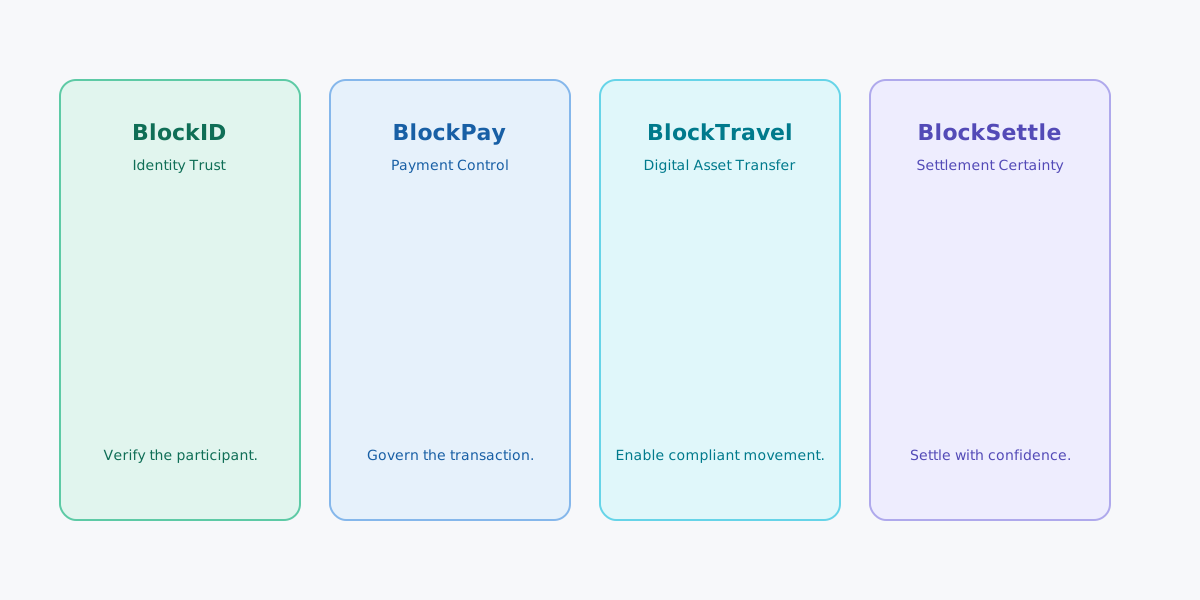
BlockID answers who you’re dealing with. BlockTravel answers whether the payment can go ahead. Two products, each solving its own compliance problem.

BlockID
Verify once. Trusted everywhere.
A distributed KYC and KYB verification network for regulated financial institutions. Verify a participant once, to the regulatory standard you already operate to, and reuse that proof across the network instead of repeating the check at every counterparty.

BlockTravel
Every payment cleared before it moves.
Compliance infrastructure for digital asset payments. Every party on every leg is screened before value moves, through Agentic Compliance, an agentic workflow using sanctions tooling, on-chain data and rules you define, with protocol-agnostic Travel Rule support built in.
Built on web3 technology. Held to the standard of regulated finance.
We use distributed ledger technology, the infrastructure behind web3, because it gives regulated institutions something their existing systems cannot: a tamper-proof record that several institutions can rely on without any one of them owning the data, and a way to make compliance a condition of a transaction rather than a check performed on it afterwards.
The technology is the means, not the message. Every control we build is designed to meet the obligations a regulated bank already carries under its existing framework: the same standard of identity verification, the same standard of sanctions screening, the same audit trail. Digital asset payments held to fiat-grade compliance, and identity verification that a supervisor would recognise.
Regulated financial institutions
Banks, payment service providers, EMIs, broker-dealers and trust companies operating under FCA, MAS or equivalent supervision. BlockID removes duplicated KYC and KYB from onboarding and ongoing due diligence, with an audit trail built to the standard your supervisor expects.
Digital asset service providers
VASPs, exchanges, custodians and regulated protocols operating under MiCA, FATF and equivalent frameworks. BlockTravel makes every digital asset payment compliant by construction, with Travel Rule messaging built in.
KYC: Know Your Customer · KYB: Know Your Business · VASP: Virtual Asset Service Provider · MiCA: Markets in Crypto-Assets regulation (EU) · FATF: Financial Action Task Force
Built to the standards our customers must operate to.
- FCA
- MAS
- GDPR
- DABA
- MiCA
- FATF Travel Rule
- OpenAPI 3.0
- Zero-knowledge Proof
- mTLS
- Immutable audit logging
- OAuth2
Standards are the floor of our work, not the ceiling. We architect to meet the regulatory frameworks our customers operate under and the technical standards their security and compliance teams require. We publish what we hold today and what we are pursuing next, without overstating either.
We’re working with a small group of regulated institutions and digital asset service providers to validate the infrastructure in production.
Design partners get early access to BlockID or BlockTravel, a direct line to the build team, influence on what ships in V1, and preferential commercial terms when each product moves out of design partner stage.
We ask for genuine integration intent, a structured feedback loop with named technical and compliance counterparts, and a mutual non-disclosure agreement (NDA). The window is short. We are validating with a small group ahead of public availability later in 2026.